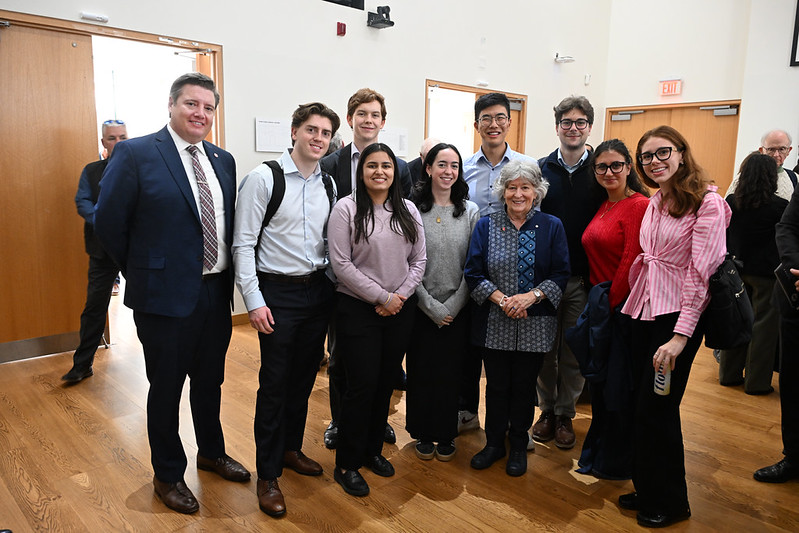
Nearly 50 years after joining the Osgoode Hall Law School faculty, Louise Arbour returned to the school this fall to discuss public trust, human rights and the foundations of democratic society with students, faculty, staff, alumni and members of the legal community.
In a conversation hosted by York University Interim President and Vice-Chancellor Lisa Philipps and Osgoode Dean Trevor Farrow, Arbour reflected on the institutions that support democratic societies, the responsibilities of those who work within them and the importance of maintaining public confidence.
Drawing on a career that has taken her from academia to the Supreme Court of Canada, international criminal tribunals and the United Nations, Arbour shared perspectives shaped by decades of work in legal and public institutions across Canada and internationally.
She spoke about the importance of understanding the foundations of law while remaining open to new perspectives and approaches. For lawyers entering a profession that continues to evolve, she emphasized the value of being prepared to learn and adapt.
Arbour first taught criminal law and evidence at Osgoode before moving into the Superior Court, Court of Appeal and later the Supreme Court of Canada. Her career also took her into international roles that required her to navigate different legal systems, languages and cultures. Those experiences, she said, reinforced the importance of listening, learning and challenging assumptions.
Despite the weight of the topics discussed, Arbour frequently drew on humour and personal anecdotes, creating an engaging and accessible conversation for students and members of the legal community.
She also reflected on the relationship between legal institutions and the people they serve. Formal rules and structures are only part of what enables organizations and public bodies to function effectively. Leadership, institutional culture and public confidence also shape how those organizations are perceived and understood.
“Louise Arbour’s career reflects the profound impact that lawyers and public institutions can have in advancing justice, human rights and democratic values,” said Farrow. “Her return to Osgoode provided an important opportunity for our community to reflect on public trust, institutional responsibility and the role that legal education plays in preparing future leaders.”
Human rights was a central theme of the discussion. Arbour encouraged critical self-reflection among those who advocate for human rights, noting that more inclusive approaches may lead to more durable commitments.
The conversation also explored how these issues intersect with challenges facing the legal profession today.
The discussion continued with a panel featuring Neha Chugh (JD ’10, LLM ’25), chair of the Law Commission of Ontario, and Sonia Lawrence, associate dean (students) at Osgoode. Together with the Governor General, they examined access to justice, reconciliation, professional responsibility and the role of legal institutions in a changing society.
For the Osgoode community, the Governor General’s return provided an opportunity to consider fundamental questions facing lawyers and legal institutions: what builds public trust, how human rights are protected and what responsibilities lawyers have in sustaining the institutions on which democratic society depends.
Arbour joined Osgoode as a young academic in 1976. Nearly five decades later, she returned to engage the next generation of lawyers in a conversation about democracy, justice, human rights and the institutions that support public trust.