
This talk unearths racial hierarchy in human rights by examining its primary sources and methods. Doing so reveals how the process of international law-making has restricted the recognition of claims and rights priorities of Black peoples. Centering anti-Blackness in human rights also reveals how conventional scholarship and pedagogical approaches to conceptualizing the origins of human rights further erasure and reinscribes the functioning of White imperial power. By surfacing whose ideas, discourses, social movements, and declarations are regarded as foundational in the discipline of human rights, this talk demonstrates how the canon conveys narratives about who the project is for, which fundamentally miseducates, distorts, and limits any potential resonance of the field. Returning to Black peoples’ early visualizations of human rights, many of which are hidden in plain sight, can help us to better understand the development of human rights and perhaps more importantly how the human rights project did not develop. Doing so allows us to consider more emancipatory futures.
Abstract
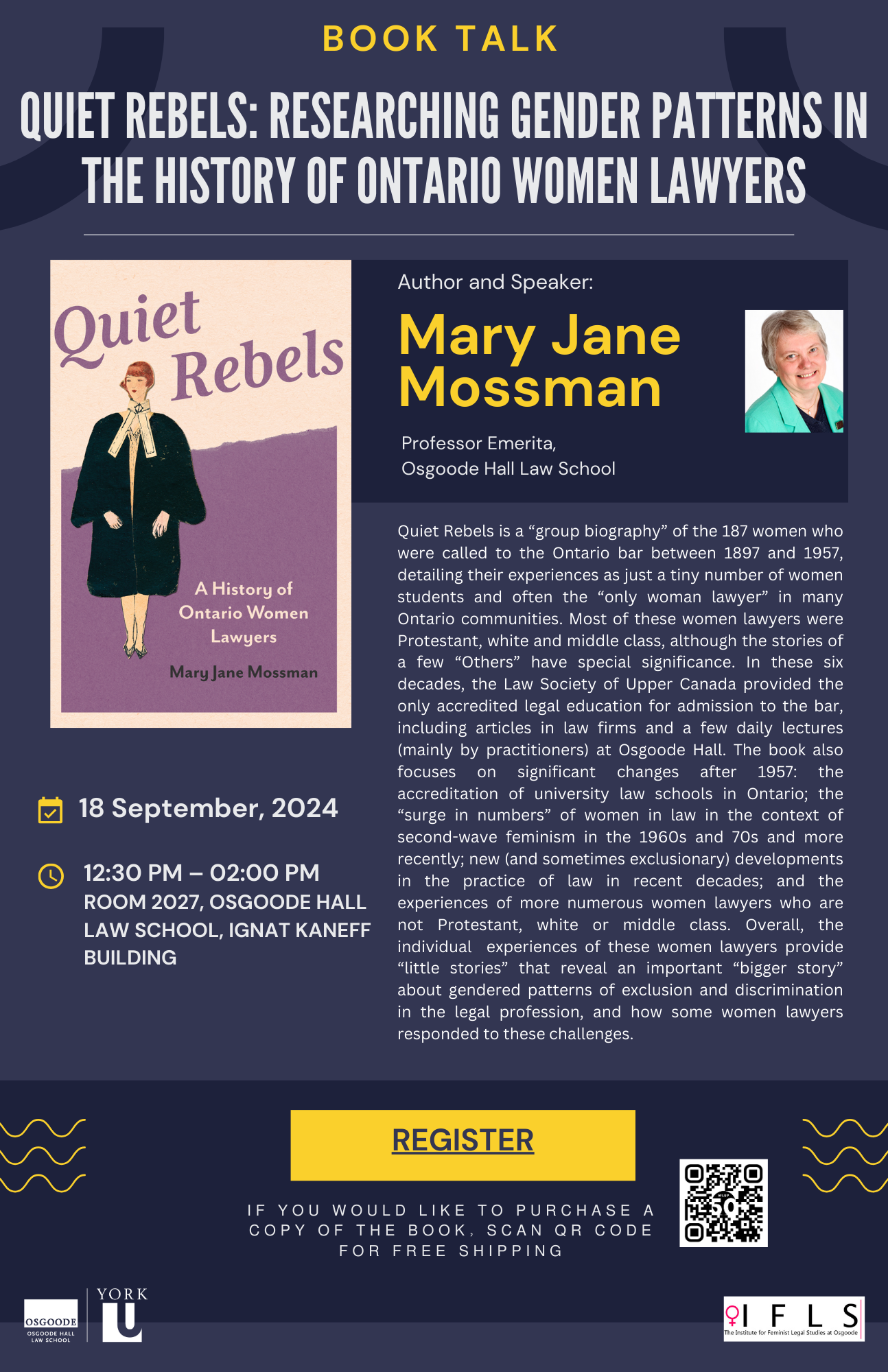
Quiet Rebels is a “group biography” of the 187 women who were called to the Ontario bar between 1897 and 1957, detailing their experiences as just a tiny number of women students and often the “only woman lawyer” in many Ontario communities. Most of these women lawyers were Protestant, white and middle class, although the stories of a few “Others” have special significance. In these six decades, the Law Society of Upper Canada provided the only accredited legal education for admission to the bar, including articles in law firms and a few daily lectures (mainly by practitioners) at Osgoode Hall. The book also focuses on significant changes after 1957: the accreditation of university law schools in Ontario; the “surge in numbers” of women in law in the context of second-wave feminism in the 1960s and 70s and more recently; new (and sometimes exclusionary) developments in the practice of law in recent decades; and the experiences of more numerous women lawyers who are not Protestant, white or middle class. Overall, the individual biographies of these women lawyers provide “little stories” that reveal an important “bigger story” about gendered patterns of exclusion and discrimination in the legal profession, and how some women lawyers responded to these challenges.